Essentially:
• Commercial and industrial boiler repair addresses cast iron and firetube boiler issues through licensed, ASME-certified technicians who diagnose, repair, and recertify equipment.
• Facilities in Cincinnati, OH rely on scheduled inspections and prompt repairs to avoid downtime, code violations, and safety hazards.
• Repair scope typically includes boiler units, condensate systems, piping, economizers, and stacks rather than a single isolated fix.
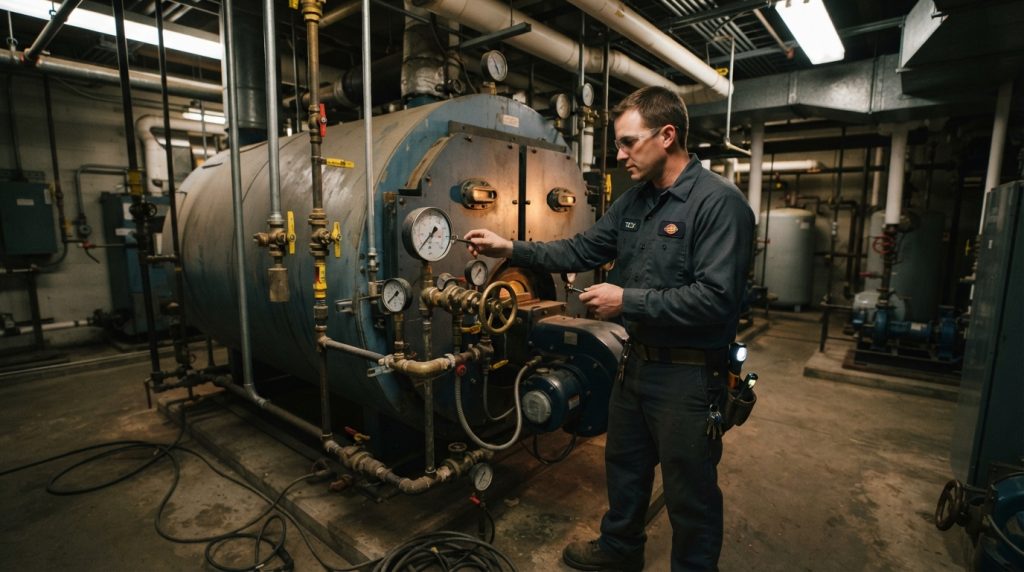
Boiler repair involves diagnosing and correcting mechanical, combustion, or pressure-related failures in commercial and industrial heating systems, typically performed by licensed technicians trained to work on cast iron and firetube boiler equipment. For facility managers, understanding this process means knowing which symptoms call for immediate attention and which repairs require a certified inspector before equipment returns to service.
Commercial facilities in Cincinnati, OH often first notice a problem through reduced hot water output, unusual boiler room noise, or a pressure gauge reading outside its normal range. Boiler Repair Services generally begin with a diagnostic inspection of the unit, its controls, and related piping before any component is replaced or adjusted. Facilities that operate firetube or cast iron systems benefit from technicians familiar with both designs, since repair methods and part availability differ between the two.
Common Signs a Boiler Needs Professional Attention
Boiler systems rarely fail without warning. Recognizing early signs helps facility managers schedule repairs before a minor issue becomes an operational shutdown.
• Inconsistent water temperature or reduced heating output across the building
• Visible leaks at joints, valves, or fittings in the boiler room
• Unusual banging, whistling, or rumbling sounds during operation
• Frequent cycling or difficulty maintaining steady pressure
• Corrosion, scaling, or discoloration on cast iron sections
Any of these symptoms warrants an inspection rather than continued operation, since pressure vessel failures can pose both safety and compliance risks.
What the Repair Process Typically Involves
Boiler repair is rarely a single-step fix. A structured process helps technicians isolate the actual cause rather than treating only the visible symptom.
1. Initial diagnostic inspection of the boiler unit, burner assembly, and connected piping to identify the source of the malfunction.
2. Component-level evaluation , which may include condensate systems, economizers, stacks, or process piping connected to the main unit.
3. Repair or part replacement , using manufacturer-compatible components when the original parts are no longer serviceable.
4. System testing and recommissioning to confirm the boiler operates within safe pressure and temperature parameters before returning to regular use.
Technicians who hold ASME certification are trained to document each step of this process, which matters for facilities subject to state boiler inspection requirements. Pressure vessel standards and inspection guidance are outlined by the Occupational Safety and Health Administration, which addresses safe installation, inspection, and testing expectations for boilers used in general industry settings.
Repair Versus Replacement: Weighing the Options
Not every boiler problem requires a full system replacement. The table below outlines general considerations facility managers weigh when deciding between repair and replacement.
| Factor | Repair | Replacement |
| Age of unit | Suitable for units with remaining service life | Often favored for units well past expected lifespan |
| Extent of damage | Effective for isolated component failures | Needed when structural or pressure vessel damage is widespread |
| Downtime tolerance | Shorter turnaround in most cases | Longer planning and installation timeline |
| Long-term cost | Lower upfront cost | Higher upfront cost, potential efficiency gains |
A qualified inspection remains the most reliable way to determine which path fits a specific system, since visual symptoms do not always indicate the full extent of internal wear.
Frequently Asked Questions
How often should a commercial boiler be inspected? Inspection frequency depends on the system type, local code requirements, and how heavily the boiler is used, so facility managers in Cincinnati, OH typically coordinate scheduling with a licensed boiler technician.
Can a cast iron boiler be repaired instead of replaced? Many cast iron boiler issues, such as section leaks or control failures, can be repaired if the overall structure remains sound, though extensive corrosion may point toward replacement.
What happens during a boiler diagnostic visit? A technician typically inspects the burner, controls, piping, and pressure components to identify the source of a malfunction before recommending a repair plan.
Is emergency boiler repair available for commercial facilities? Availability varies by provider, and facility managers should confirm response times and after-hours service directly with a licensed boiler repair company.
Finding Boiler Repair Support
Based in Milford, OH, The Schweitzer Brothers Co serves customers across Cincinnati, OH.
Read More about The Schweitzer Brothers Co. for current scheduling information of commercial boiler diagnostics and repair work is available through.