Briefly:
-
Montana’s water quality varies sharply by location, with private wells facing elevated risks from arsenic, nitrates, iron, and other naturally occurring contaminants.
-
Selecting the right filtration system requires a professional water test first, then matching the technology to the specific contaminants present.
-
Whole-home, reverse osmosis, and UV systems each address different threats and are often combined for comprehensive protection.
Choosing the right home water filtration system starts with understanding what is actually in your water. In Montana, that answer depends heavily on whether your home connects to a municipal supply or draws from a private well.
Understanding Montana’s Water Quality Challenges
Montana’s geology creates a wide range of water quality conditions across the state. While 86% of residents rely on public water systems that generally meet federal standards, serious concerns exist, including natural arsenic contamination from geothermal sources and widespread rural well contamination.
The situation is especially pressing for rural households. Approximately 94% of rural domestic water comes from unregulated private wells that may contain arsenic, nitrates, and bacteria. A 2025 USGS-published study found that an analysis of nearly 84,000 data points from over 6,500 wells across 51 of Montana’s 98 watersheds found that arsenic and uranium contributed the most cumulative health risk, followed by strontium, fluoride, manganese, and boron.
According to the Montana Department of Environmental Quality, Montana publishes an annual Public Water System Compliance Report covering all public water supply systems in the state. Private well owners, however, are not covered by those regulations and bear full responsibility for their own water quality.
Common contaminants to test for in Montana include:
-
Arsenic (naturally occurring in bedrock, especially in southwestern and north-central regions)
-
Nitrates (prevalent in irrigated valleys such as Flathead, Missoula, and the Yellowstone Valley)
-
Iron and manganese (cause staining, metallic taste, and plumbing damage)
-
Bacteria, including total coliform and E. coli
-
Hardness minerals (calcium and magnesium)
-
Radon (found in areas with high uranium content, such as the Boulder Batholith region)
Comparing Common Water Filtration System Types
Matching the filtration technology to the confirmed contaminant is the most critical step. The table below outlines the most widely used residential systems and what each addresses.
|
System Type |
Best For |
Key Limitation |
|
Reverse Osmosis (RO) |
Arsenic, nitrates, fluoride, lead, uranium |
Slower flow; requires storage tank |
|
Whole-Home Carbon Filter |
Chlorine, sediment, taste, odor |
Does not remove dissolved metals |
|
Water Softener |
Hard water (calcium, magnesium scale) |
Adds sodium; not a contaminant filter |
|
UV Disinfection |
Bacteria, viruses, protozoa |
Does not remove chemical contaminants |
|
Oxidizing/Iron Filter |
Iron, manganese, sulfur |
Requires backwashing maintenance |
Many Montana households require a combination of systems. For example, a well with both high iron and arsenic may need an oxidizing filter followed by a reverse osmosis unit at the point of use.
How to Choose and Install the Right System
Follow these steps to select a system that fits your property and water source:
-
Get a professional water test. A laboratory panel covering bacteria, nitrates, arsenic, hardness, iron, manganese, pH, and total dissolved solids gives you a reliable baseline. Montana does not mandate water testing for private wells, but it is strongly recommended because many dangerous contaminants are invisible, tasteless, and odorless.
-
Identify your priority contaminants. Review results against EPA Maximum Contaminant Levels. Arsenic, nitrates, and bacteria are the most frequently cited concerns in Montana groundwater.
-
Choose the appropriate technology. Use the comparison table above as a starting guide. For arsenic and nitrates, reverse osmosis is the most effective point-of-use solution. For bacterial risk, add UV disinfection.
-
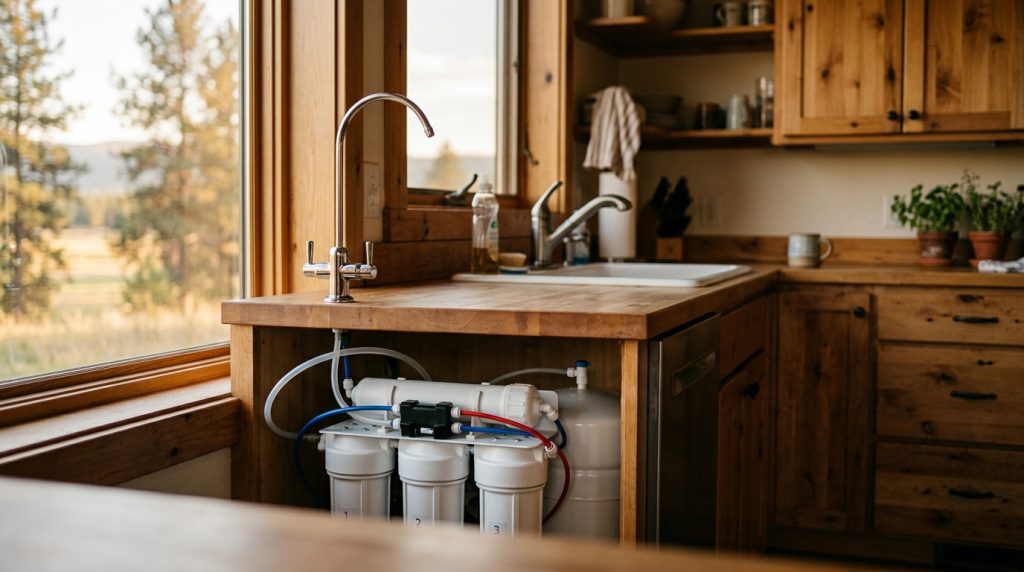
Plan for whole-home versus point-of-use. Whole-home systems protect all fixtures and appliances. Point-of-use systems (typically under-sink RO units) deliver higher-purity water at a single tap at lower upfront cost.
-
Schedule professional installation. Same-day water testing and whole-home installations completed within one to two days minimize disruption to your household routine.
-
Set a maintenance schedule. Ongoing maintenance, filter changes, and prompt support visits are essential to sustained water quality. RO membranes typically require replacement every two to three years; sediment pre-filters may need attention every six months.
Frequently Asked Questions
Do I need a whole-home system or a point-of-use filter? That depends on your water test results. If contaminants affect appliances and fixtures (such as iron staining or hard water scale), a whole-home system is appropriate. If the concern is drinking water quality alone, a point-of-use reverse osmosis unit is often sufficient.
How often should I test my well water in Montana? The EPA recommends testing annually for bacteria (total coliform, E. coli), nitrate, total dissolved solids, and pH. Test for arsenic at least once, and again after any well repairs or changes in water appearance.
Can a water softener replace a filtration system? No. A water softener addresses hardness minerals only. It does not remove arsenic, nitrates, bacteria, or other health-related contaminants. Most households with well water benefit from both a softener and a dedicated filtration system.
What contaminants does reverse osmosis remove? Advanced water filtration and treatment systems can effectively remove or reduce common contaminants including nitrate, fluoride, arsenic, iron, manganese, lead, uranium, sediment, and hardness minerals. Confirm specific removal rates with the manufacturer’s performance data sheet.
For residents across Helena, Billings, Great Falls, Kalispell, and surrounding communities, Water Filtration Systems in Montana are available through professional providers who can test, design, and install a system matched to your property’s specific water profile. 180 Water offers complimentary water testing, whole-home installations, and ongoing maintenance support for residential, ranch, and commercial properties throughout the region. Contact their team to schedule a no-cost water assessment and take the first step toward consistently cleaner water at every tap.