Summary:
• Effective building maintenance combines planned preventive servicing, reactive repairs, and statutory compliance checks for mechanical and electrical systems.
• Commercial property owners across Greater London face legal obligations tied to fire safety, electrical systems, and ventilation that require documented, scheduled inspections.
• A structured maintenance plan reduces long-term repair costs and keeps buildings operating safely and in compliance with current regulations.
Commercial property owners ask a simple question when planning upkeep: what does proper building maintenance actually involve? At its core, it means a structured combination of planned preventive servicing, prompt reactive repairs, and documented compliance checks that keep mechanical, electrical, and structural systems functioning safely over time.
Building maintenance covers far more than fixing problems as they appear. For commercial and industrial sites, it typically spans heating and ventilation systems, electrical distribution, emergency lighting, fire alarm systems, and general mechanical plant, all of which require regular attention to avoid costly breakdowns and safety violations.
Property managers who treat maintenance as a scheduled program rather than a reactive expense tend to see fewer emergency callouts and lower lifetime costs on major equipment.
Planned Preventive Maintenance vs Reactive Repairs
Most commercial maintenance strategies rely on two complementary approaches.
Planned preventive maintenance (PPM) involves scheduled inspections and servicing based on asset condition, statutory obligations, and operational needs, rather than waiting for a failure to occur.
Reactive maintenance addresses unexpected breakdowns or faults as they happen, ideally supported by a responsive team that can limit downtime and prevent secondary damage.
| Maintenance Type | Primary Goal | Typical Trigger | Cost Impact |
| Planned Preventive (PPM) | Prevent failures before they occur | Fixed schedule or asset condition | Lower long-term cost |
| Reactive | Restore function after a fault | Equipment failure or complaint | Higher per-incident cost |
| Compliance Servicing | Meet legal/safety obligations | Statutory deadline | Fixed, recurring |
A balanced program uses PPM for predictable wear items and reserves reactive capacity for genuine emergencies, rather than letting avoidable issues escalate into urgent repairs.
Compliance Servicing for Commercial Buildings
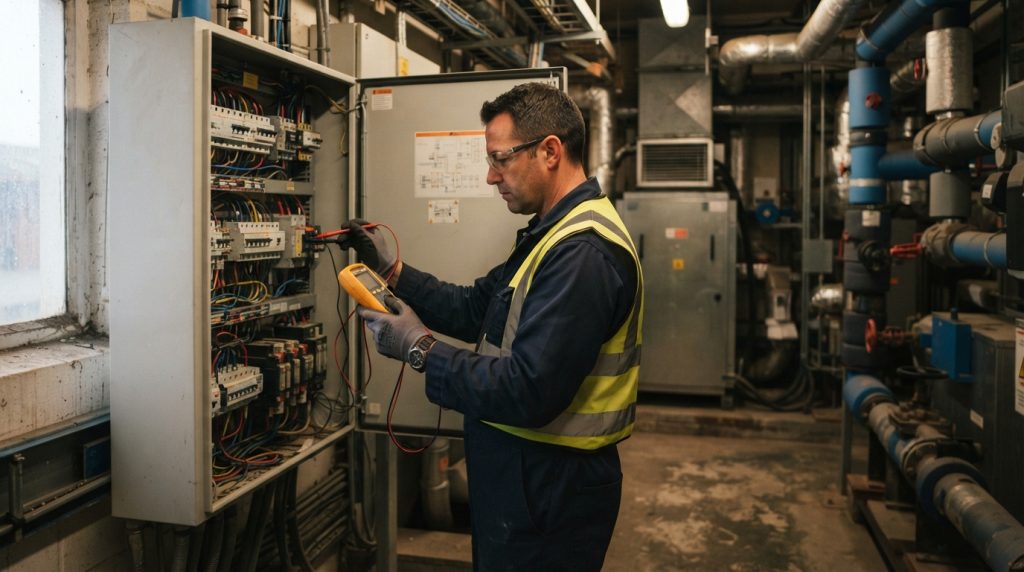
Statutory compliance is not optional for commercial property owners. Electrical installations in particular fall under specific legal maintenance duties, and the HSE electrical inspection guidance outlines the standards that commercial premises must follow to keep wiring and fixed installations safe for continued use.
Typical compliance areas include:
• Fire alarm testing and periodic servicing
• Electrical installation condition reporting
• Portable appliance testing where risk assessment indicates it is needed
• Emergency lighting checks
• Ventilation and HVAC system servicing
Every inspection should be documented with condition reports, so building owners have a clear record for insurers, regulators, and future planning rather than relying on memory or informal notes.
Building Maintenance Considerations in Greater London
Older commercial building stock across Greater London often combines aging mechanical plant with more recent compliance requirements, which can create gaps between what a system was designed to do and what current regulations expect of it. Seasonal demand on heating and cooling systems, combined with dense, mixed-use developments, also means that scheduling matters: planned works are often phased so that a building can remain occupied and operational while equipment is renewed in stages.
Based in London, Core Integrated Group serves clients across Greater London, where many commercial properties require coordinated planned maintenance, reactive support, and compliance servicing under a single accountable structure. Verified service details describe planned preventive maintenance, reactive callouts, and compliance servicing for commercial and industrial buildings, alongside mechanical and electrical installation and finishing work.
How often should commercial building systems be inspected? Inspection frequency depends on the system and applicable regulation; some areas like fire alarms follow fixed servicing intervals, while others are based on risk assessment and manufacturer guidance rather than a single universal rule.
What is the difference between planned and reactive maintenance? Planned maintenance follows a set schedule to prevent problems before they occur, while reactive maintenance responds to faults or breakdowns after they happen.
Who is responsible for statutory compliance in a commercial building? The accountable person, typically the building owner, landlord, or appointed facilities manager, holds responsibility for ensuring statutory inspections and servicing are completed and documented.
Does preventive maintenance actually reduce costs? Scheduled servicing generally identifies minor issues before they become major failures, which tends to lower emergency repair costs and extend the working life of mechanical and electrical plant.
Consistent documentation, scheduled servicing, and a clear compliance calendar remain the most reliable ways for property owners to keep commercial buildings safe and operational over time. Current listing information for Core Integrated Group is available for review by property managers researching service options in the area.