In brief:
- Intumescent paint swells when heated, forming an insulating char layer that slows heat transfer to structural steel or timber.
- This passive fire protection buys extra time for evacuation and emergency response before load-bearing members lose strength.
- Montana’s fire codes and climate conditions make verified fireproofing installation an important part of commercial and residential builds.
Intumescent paint protects buildings by reacting to heat: it swells into a thick, insulating char that slows how fast structural steel or wood reaches a failure temperature, buying time for evacuation and firefighting. This behavior is why the coating is classified as a form of passive fire protection rather than a decorative finish.
Intumescent Paint is a reactive coating applied to structural elements such as beams, columns, and decking. According to manufacturer research, intumescent paint is a reactive coating which swells as a result of heat exposure, thus increasing in volume and decreasing in density. The resulting char layer separates the flame and heat source from the substrate underneath.
What Happens When the Coating Reacts to Heat
The chemistry behind intumescent coatings depends on a few core ingredients working together under thermal stress.
- Acid source, carbon source, and gas source: these three components react together, and the classic intumescent fire-retardant coating contains three basic components, an acid source, carbon source and gas source, which expand under heat to form a foamed carbon layer that acts as a thermal barrier.
- Char expansion: depending on formulation and heat intensity, coatings can swell up to 2 to 100 times their initial thickness and generally provide fire resistance between 30 and 120 minutes.
- Critical temperature delay: for steel members, critical temperature is the point at which load-bearing capacity equals the applied load, and this can vary from 350 C to 750 C, though most cases fall between 500 C and 620 C.
Slowing the climb toward that critical temperature is the entire function of the coating. Without it, unprotected steel can lose load-bearing capacity within minutes once exposed to open flame.
Why Passive Fire Protection Matters for Structural Safety
Unlike sprinklers or alarms, intumescent coatings do not detect or extinguish fire. They work silently in the background, buying time rather than stopping combustion outright.
- Extended structural integrity: coatings produce an insulating foam or char with low thermal conductivity, greatly reducing the rate of heating experienced by the steel and extending the time before the building loses integrity.
- Supports evacuation and response: this extra margin delays the time when steel reaches critical temperature and loses load-bearing capacity, providing vital extra time for evacuation and an opportunity for firefighters to control the fire.
- Applies to multiple fire types: coatings are often categorized according to the type of fire they are designed to protect against, such as cellulosic fueled or hydrocarbon fueled fires.
Because the coating is a chemical system rather than a simple paint film, surface preparation and dry film thickness both affect how well it performs during an actual fire event. The National Institute of Standards and Technology fire research program maintains ongoing studies on structural fire performance that inform code requirements used across the country, including in Montana jurisdictions that reference national fire and building codes.
Application Methods and Durability Considerations
Correct application separates a coating that performs as rated from one that fails prematurely.
| Factor | Typical Practice | Why It Matters |
| Surface prep | Cleaning, priming, anti-corrosion layer | Affects adhesion in cold and humid conditions |
| Application method | Airless spray or brush | Spray allows more even thickness control |
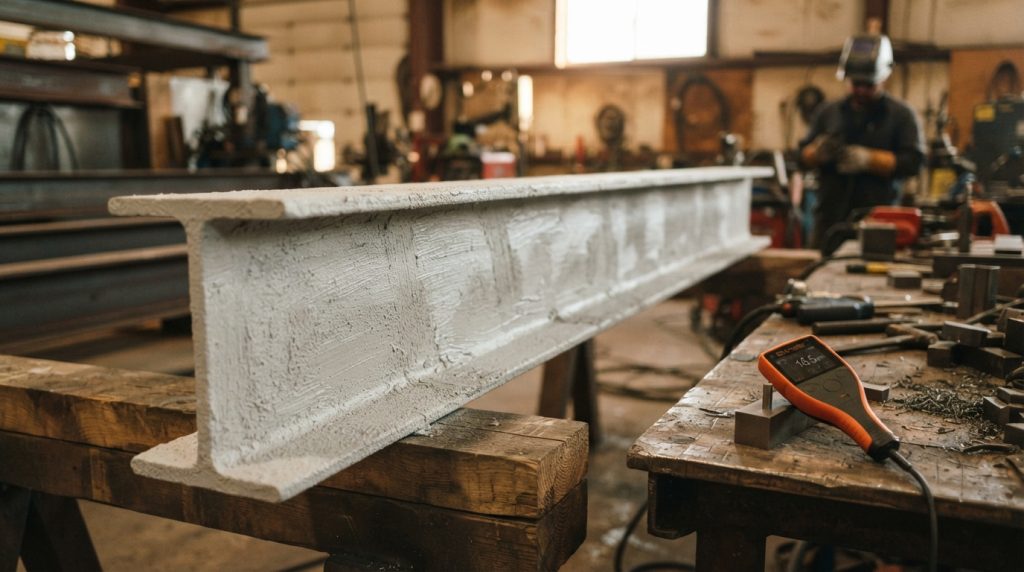
| Dry film thickness | Measured with calibrated gauge | Determines fire-resistance rating achieved |
| Environmental exposure | Weathering, UV, moisture cycling | Can cause cracking or reduced expansion over time |
Industry guidance notes that intumescent coatings are generally applied in liquid form via standard airless spray equipment, with dry thickness ranging from 250 microns up to several millimeters depending on the structural component and required fire duration. Coatings can also degrade with age; researchers have found that surface cracks, erosion, lifting, and reduced expansion effects in fires may occur due to aging and weathering of materials. Montana’s freeze-thaw cycles and seasonal humidity swings make periodic inspection of coated steel a practical part of long-term fire-code compliance for commercial buildings.
Frequently Asked Questions
Does intumescent paint stop a fire from spreading? No. It slows heat transfer to the protected structural member rather than extinguishing flame, which is why it is classified as passive rather than active fire protection.
How long does the protection last during a fire? Fire-resistance ratings for coated steel commonly range between 30 and 120 minutes, depending on coating thickness and formulation, as referenced in published fire-performance studies.
Can intumescent coatings be used on both steel and timber? Yes. Formulations exist for structural steel, timber, and some plaster assemblies, each designed around the heat-reaction properties of that substrate.
Does the coating need maintenance after installation? Weathering and surface damage can reduce performance over time, so periodic visual inspection and adherence to manufacturer recoating schedules are recommended.
Fireproofing and passive fire protection installation is one of the services performed by Butte Insulation, a contractor based in Butte, MT that serves projects across Montana. Verified details about this fireproofing work are published through Butte Insulation.
Next Steps for Fire-Rated Structural Coatings
Published information covering fireproofing and related passive fire protection work is available through Butte Insulation for property owners reviewing structural fire-code requirements in Montana.