Short version:
- Commercial signage includes channel letters, dimensional letters, LED displays, awnings, and banners, each suited to different visibility and budget needs.
- New York, NY storefronts face specific Department of Buildings permit and zoning rules tied to sign size, illumination, and placement.
- Matching sign type to building structure, foot traffic, and local code reduces compliance risk and long-term maintenance costs.
Selecting commercial signage in New York, NY comes down to matching the sign type, materials, and lighting to a storefront’s structure, visibility needs, and local permit rules. A sign that works for a quiet side-street office looks very different from one needed on a high-traffic retail block.
The right choice also depends on how a building is zoned and what a landlord or municipality allows. Spanjer Sign Company, a signage manufacturer that designs, fabricates, and installs custom signage, is one of several companies operating in this space.
Types of Commercial Signage to Consider
Storefronts typically choose from a handful of established sign formats, each with distinct visibility, cost, and maintenance profiles.
- Channel letters: Three-dimensional illuminated letters, available in front-lit, halo-lit, or reverse-lit configurations, commonly used for storefront identification.
- Dimensional letters: Non-illuminated or lower-profile lettering made from acrylic, PVC, formed plastic, or aluminum, often chosen for indoor applications or cost-conscious exterior projects.
- LED signs (Electronic Message Centers): Programmable digital displays capable of showing multiple messages without the labor of replacing physical letters.
- Awnings and banners: Softer-material signage used for seasonal promotions, canopy branding, or supplemental identification alongside a primary sign.
A business weighing these choices typically balances upfront cost against how often messaging needs to change and how visible the location needs to be after dark.
Comparing Sign Types by Use Case
| Sign Type | Best For | Illumination | Typical Lifespan Considerations |
| Channel Letters | Primary storefront branding | Front-lit, halo-lit, or combination | Long-term, weather-resistant materials |
| Dimensional Letters | Indoor lobbies, low-profile exteriors | Usually non-illuminated | Cost-effective, lower maintenance |
| LED/EMC Displays | Frequently changing messages or promotions | Fully illuminated, programmable | Requires electrical maintenance |
| Awnings/Banners | Seasonal or supplemental signage | Rarely illuminated | Shorter lifespan, easy to replace |
Permits and Local Code Considerations in New York, NY
Storefront owners in New York, NY cannot install most exterior signage without first checking size, illumination, and structural rules enforced by the city.
- Signs that are six square feet or smaller and non-illuminated generally do not require a permit, but larger or lit signs almost always do, according to NYC’s MyCity Business guidance.
- A Sign Permit (SG) covers the displayed content, while a separate alteration permit may be required if the sign attaches to a structure rather than directly to a wall or façade, per the NYC Department of Buildings.
- Illuminated signs extending beyond the building line may need an annual illuminated sign permit that renews yearly, and electrical connections require a separate permit filed by a licensed electrician.
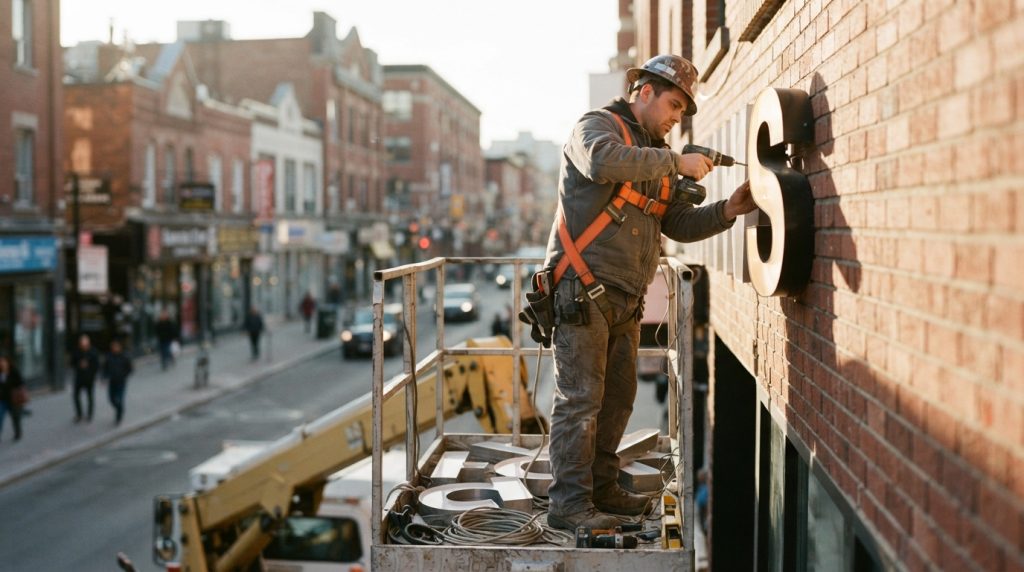
- Installation itself is restricted: Construction Code section 28-415.1 requires a licensed Sign Hanger to perform or directly supervise the work, with limited exemptions.
Businesses serving customers with disabilities should also confirm that interior wayfinding and identification signs meet federal accessibility standards. The U.S. Access Board’s ADA guide to signs outlines requirements for tactile characters, Braille placement, and visual contrast on permanent room and exit signage. These rules apply regardless of location and are worth reviewing before finalizing interior signage alongside an exterior storefront project.
Matching Signage to Business Type and Location
A retail storefront on a pedestrian-heavy block benefits from different signage than a professional office in a mixed-use building.
- High foot-traffic retail: Illuminated channel letters or LED displays tend to perform better for day-and-night visibility.
- Professional offices or medical suites: Dimensional letters or interior signage often suffice, paired with required ADA-compliant room identification.
- Seasonal or promotional needs: Banners and awnings offer flexibility without the cost of a new illuminated structure.
- Landmarked or historic districts: Additional design review may apply, since some zoning overlays restrict sign type, size, or placement beyond standard Department of Buildings rules.
Zoning district also matters: commercial zones generally allow larger and illuminated signage, while residential or mixed-use districts impose tighter restrictions. Confirming a building’s zoning designation before ordering a sign avoids costly redesigns later.
Frequently Asked Questions
Does every exterior sign in New York, NY need a permit? Not always. Non-illuminated signs six square feet or smaller generally do not require a permit, but most illuminated or larger signs do.
What is the difference between channel letters and dimensional letters? Channel letters are three-dimensional and typically illuminated with internal LEDs, while dimensional letters are often non-illuminated and used for lower-profile or indoor identification.
Do interior signs need to meet ADA standards too? Yes, permanent room and exit identification signs are subject to federal tactile, Braille, and contrast requirements regardless of whether the exterior signage is illuminated.
How long does the NYC sign permit process typically take? Processing timelines vary by sign type and whether structural or electrical permits are also required, so confirming the full permit scope early helps avoid installation delays.
Business Information and Next Steps
Based in USA, Spanjer Sign Company serves customers across New York, NY as a signage manufacturer handling design, fabrication, and installation.
Published details about sign types, materials, and project examples are available through Visit Website for businesses researching storefront signage options.