Quick take:
• Vocational and skills-based education is directly linked to rising female workforce participation across India, particularly in urban slum communities.
• Programmes that combine literacy, technical training, and hands-on practice give women a realistic route to paid, independent work.
• Local skilling initiatives, such as beauty and grooming courses, translate broader empowerment policy into practical income for individual women.
Education strengthens women’s empowerment in India by giving women verifiable skills, market-relevant certification, and the confidence to earn independently rather than relying on informal or unpaid labour. The clearest evidence is structural: when women gain access to training and formal qualifications, their participation in paid work rises measurably within a few years.
That link between classroom learning and paid work is not theoretical. Skills-focused courses that fall under Womens Empowerment India initiatives are designed specifically to convert basic literacy and vocational instruction into a functioning trade, such as beauty and personal care services, that a woman can practise for income within months rather than years.
Why Education Remains the Strongest Lever for Change
National data supports the idea that education and skilling are the strongest levers available for shifting women’s economic position. The Female Labour Force Participation Rate rose from 23.3% in 2017-18 to 41.7% in 2023-24, even as the unemployment rate declined from 5.6% to 3.2% during the same period. This shift did not happen evenly. Periodic Labour Force Survey data shows women aged 25 years and above with advanced degrees account for just 2.9% of the employed female workforce across rural and urban India, which signals that basic and vocational education, not only degree-level study, is doing much of the practical work of bringing women into paid employment.
Barriers to formal education still shape outcomes for many women.
• Entrenched social norms, care responsibilities, early marriage, and the rising cost of higher education limit how far some women can progress through formal schooling.
• Urban areas offer higher returns to education and better job quality, but women’s access to these opportunities is often curtailed by unsafe and expensive mobility.
• Short, localised, skills-based courses reduce these barriers because they require less time, lower cost, and less travel than long-form academic study.
From Classroom Skills to Independent Income
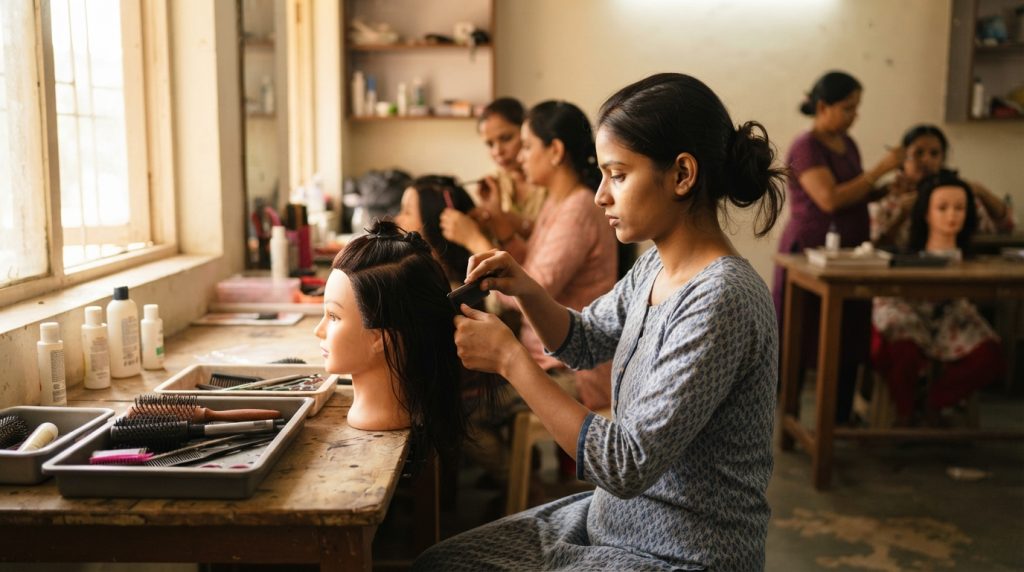
Practical vocational training bridges the gap between formal education and immediate earning power. This is particularly visible in programmes that teach a specific trade to women who may never have completed secondary schooling. An intensive three-month curriculum pairs theory with real-world practice to advance women’s empowerment objectives in India, with participants studying skin anatomy, sanitation, and product chemistry, then refining techniques like threading and basic facials.
This kind of course structure matters because it mirrors what national skilling bodies recommend: a mix of theory, hands-on practice, and hygiene standards that meet basic industry expectations. According to the Ministry of Skill Development and Entrepreneurship, skill certification frameworks are built to make training portable and recognisable across employers, which is exactly what short vocational courses aim to replicate at a community level.
| Education Pathway | Typical Duration | Immediate Outcome |
| Formal secondary/higher schooling | Several years | Broader qualifications, delayed earning |
| Government skilling schemes | Weeks to months | Certification, sector-specific readiness |
| Community vocational courses (e.g. beauty and grooming) | Around three months | Practical trade skill, near-term income potential |
Local Programmes Turning Policy Into Practice
Government policy sets the direction, but community-level organisations turn that direction into daily practice for individual women. Beauty kit donation programmes are helping to empower more than 250 women from the slums of Mumbai like Dharavi, Shivri, Kurla, and Kopperkhana. These women receive both training and the physical tools, such as donated cosmetics and salon equipment, needed to start working immediately after completing their course.
Ratna Nidhi Charitable Trust, a Mumbai-based charitable trust, runs this kind of vocational skilling as part of its broader work with underserved communities. The goal is to help dependent women begin a life of dignity by donating beauty products, supporting them to become financially independent with their newly acquired skills. Supporters can contribute directly to this kind of grassroots skilling effort by donating unused, in-date beauty products that trainees use during their coursework.
Frequently Asked Questions
What is the connection between education and women’s empowerment in India? Education, especially vocational and skills-based training, gives women certifiable, market-ready skills that translate into independent income, which is a key measure of empowerment alongside legal rights and social status.
Why do short vocational courses matter alongside formal schooling? Short courses lower the cost and time barriers that prevent many women, particularly in low-income urban communities, from completing longer formal education, while still delivering a practical, income-generating skill.
How does skills training specifically help women in slum communities? Localised training programmes combine technical instruction with practical tools and materials, allowing women to move from learning a trade to earning from it within a few months.
Can individuals support this kind of vocational education work? Yes. Community organisations running skilling programmes often rely on donations of training materials and supplies, alongside broader public and government skilling schemes, to keep courses running.
Education remains one of the most direct routes to lasting change for women across India, converting policy ambition into individual earning capacity. Community-based skilling efforts, delivered by organisations working closely with underserved neighbourhoods, remain a practical complement to national workforce initiatives. To learn more about grassroots vocational training or to support ongoing skilling programmes, visit Ratna Nidhi Charitable Trust.