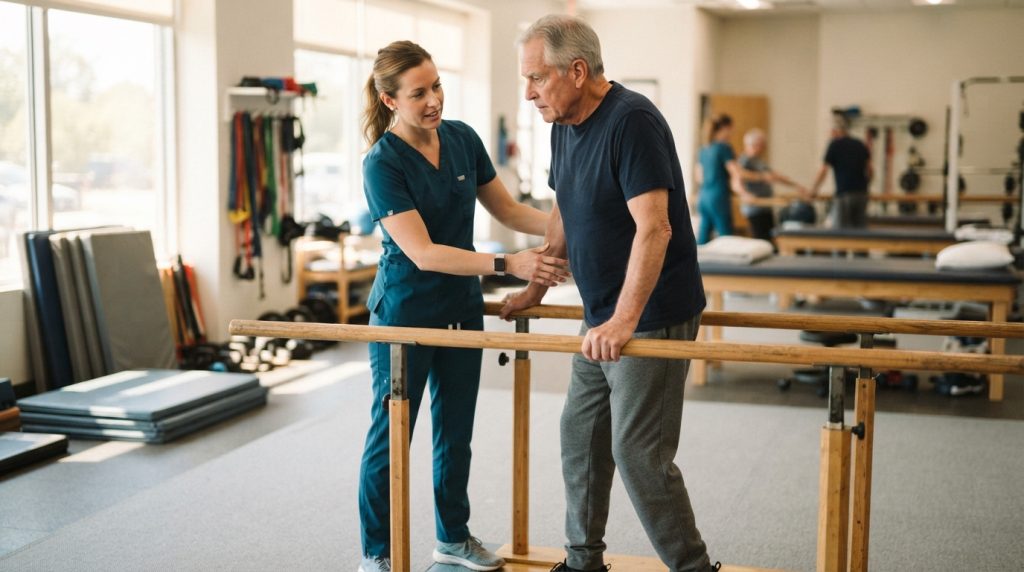
Short answer:
- A rehab therapist helps patients recover physical, cognitive, or functional abilities after injury or illness through structured treatment plans.
- Entry typically requires a relevant degree, state licensure, and supervised clinical training specific to the therapy discipline.
- Demand for rehabilitation professionals is rising as physical therapist employment is projected to grow 12% from 2025 to 2035, much faster than average, according to the Bureau of Labor Statistics.
A rehab therapist is a licensed professional who works with patients recovering from injury, surgery, illness, or neurological conditions to restore movement, independence, and daily function. The field includes several specialties, such as physical, occupational, speech, and recreational therapy, each requiring distinct education paths and licensing standards. For readers in Kansas City, KS researching this career or seeking treatment options, understanding how a Rehab Therapist is trained helps clarify what to expect from a rehabilitation program.
Rehabilitation therapy is not a single job title but a category covering multiple licensed disciplines. Each specialty treats different conditions and follows its own education and certification track.
What Does a Rehab Therapist Actually Do
Daily responsibilities vary by specialty, but most rehab therapists share a common workflow built around assessment, goal-setting, and measurable progress tracking.
- Evaluate a patient’s physical, cognitive, or communication limitations following injury or diagnosis
- Design individualized treatment plans with short-term and long-term functional goals
- Deliver hands-on therapy sessions, exercises, or cognitive retraining activities
- Document progress and adjust treatment in coordination with physicians and other care team members
- Educate patients and families on home exercise programs and safety strategies
For patients recovering from brain or spinal cord injuries, treatment often requires coordination between a rehab physician and therapy specialists who track progress together. This team-based model is common at residential rehabilitation programs where therapy intensity and medical oversight must stay aligned.
Education and Licensing Requirements
Each rehab therapy discipline has its own degree and licensure path, though all require passing a national or state exam before practicing independently.
| Discipline | Typical Degree | Licensing Exam |
| Physical Therapist | Doctor of Physical Therapy (DPT) | National Physical Therapy Examination |
| Occupational Therapist | Master’s or Doctoral degree | National Board for Certification in OT exam |
| Recreational Therapist | Bachelor’s degree | National Council for Therapeutic Recreation Certification |
| Speech-Language Pathologist | Master’s degree | Praxis exam in speech-language pathology |
Recreational therapists, for example, typically need a bachelor’s degree and the Occupational Outlook Handbook notes this specialty is projected to grow 5 percent from 2025 to 2035, faster than the average for all occupations. Licensure requirements also vary by state, so candidates should confirm specific rules with their state licensing board before applying for exams.
Core Skills Every Rehab Therapist Needs
Beyond formal credentials, successful rehab therapists develop a consistent set of clinical and interpersonal skills:
- Clinical assessment ability to identify functional deficits accurately
- Treatment planning that adapts to a patient’s changing condition
- Clear communication with patients, families, and multidisciplinary teams
- Physical stamina for hands-on therapy techniques
- Documentation accuracy for insurance and medical record compliance
Patients and families in Kansas City, KS evaluating a rehabilitation provider often look for teams where physicians and therapists communicate regularly, since coordinated care tends to produce more consistent functional outcomes than therapy delivered in isolation.
Career Outlook for Rehab Therapy Professions
Employment growth varies notably across rehab therapy specialties, reflecting differences in demand, settings, and patient populations served.
- Physical therapist employment is projected to grow 12 percent from 2025 to 2035, with about 13,400 annual openings, according to BLS data.
- Recreational therapist employment is projected to grow 5 percent over the same period, with about 1,400 openings projected annually.
- Growth is driven in part by an aging population and rising rates of chronic disease requiring ongoing rehabilitation support.
These figures suggest steady, if uneven, demand across rehab therapy specialties, with physical therapy showing the strongest projected growth among licensed rehabilitation roles.
Frequently Asked Questions
How long does it take to become a licensed rehab therapist? Timelines depend on specialty: physical and occupational therapy typically require three to seven years of postsecondary education, while recreational therapy can be completed with a four-year bachelor’s degree.
Do rehab therapists need a state license? Yes, all major rehab therapy disciplines require passing a national certification exam and obtaining state licensure before practicing independently.
What conditions do rehab therapists commonly treat? Common conditions include stroke, traumatic brain injury, spinal cord injury, orthopedic surgery recovery, and chronic neurological disorders.
Is rehab therapy a growing career field? Growth varies by specialty, but physical therapy is projected to grow 12 percent from 2025 to 2035, well above the average for all occupations.
Finding Rehabilitation Support
Based in Shawnee, KS, Neuro RehabCare Kansas City serves individuals and families across Kansas City, KS who are navigating recovery from brain, spinal cord, or catastrophic injury.
Information about neurological rehabilitation programs and treatment approaches is detailed in Read more about rehab therapy.